
Lawton Collections of City Directories
Lawton's historical shelf is strongest when treated as a group of related collections, rather than as one continuous printed run. The Lawton Public Library confirms city and neighboring-community directories and phone books, while the locally reported R. L. Polk & Co. volume is directly evidenced for 1905. The library does not publish a complete shelf list online. That matters: a catalog result can point to a useful edition without proving that every year is present on the local shelf. The table separates confirmed facts from leads that need a call or a catalog check.
| Collection | Years | Where Held | Access |
|---|---|---|---|
| Lawton and neighboring city/phone directories | R. L. Polk & Co. confirmed in 1905; catalog leads for 1903, 1905, 1907, 1909, 1911, 1913, 1917, 1926, 1930, 1932, 1936, 1937, 1941, 1950, 1952, 1955, 1957, and 1960 | Lawton Public Library Family & Local History Room; OHS Research Center; some digitized sources | Check shelf or catalog for each lead; no complete local run is published |
| Lawton Constitution | Library archive 1904-2022, with small gaps | Library microfilm, Access World News, and Gateway to Oklahoma History | Library and online channels have different, narrower date ranges |
| School yearbooks and local indexes | Years vary; no complete online list | Lawton Public Library | In-room and library-assisted research |
| Highland Cemetery Records | 1901-1994 | FamilySearch, library copies, and cemetery channels | 26,550 records in the inspected FamilySearch collection list |
Directories can name a household, but they do not replace every companion source. The Constitution can supply a move, obituary, marriage notice, or business mention. Yearbooks and local indexes can distinguish a same-name person. A cemetery record may supply the endpoint after a final listing.
Lawton City Directory Years Need Checking
The documented year list is deliberately cautious. The scattered years in the table are catalog or digitization leads to verify, not a claim of a complete Polk, phone-book, or criss-cross sequence. Call the Family & Local History Room at 580-581-3450 or inspect the catalog before building a year-by-year timeline around a surname. The room is at 110 SW 4th Street in Lawton and holds more than 40,000 genealogy resources arranged by state and county, including directories, yearbooks, newspapers, biographical files, rare Oklahoma titles, and material connected with Kiowa, Comanche, and Apache history.
Lawton Public Library's Family & Local History Room identifies the local directory, newspaper, and index resources available for this work.
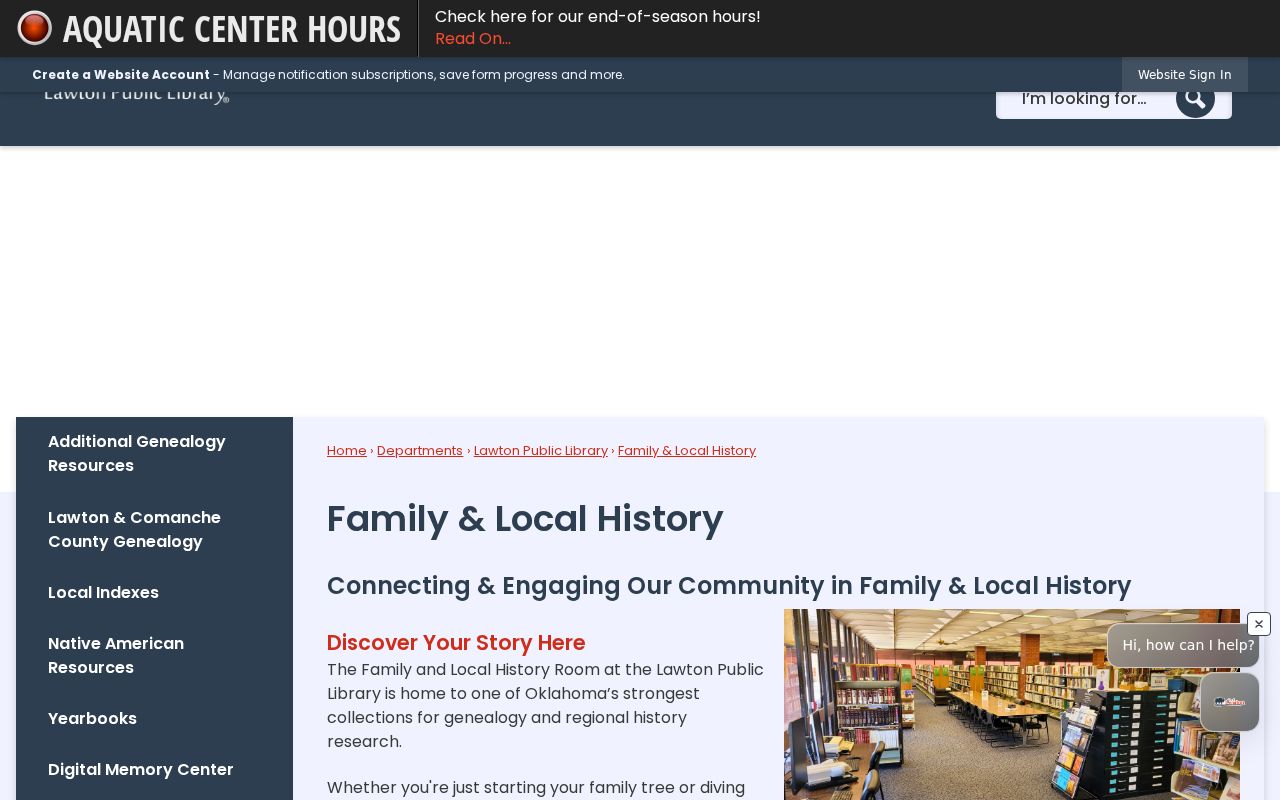
The library also offers limited lookup requests, although a detailed inquiry may require in-room work. Ancestry Library Edition is available on the main library computers or library Wi-Fi, FamilySearch is an affiliate-library service, Access World News uses a library-card login, and Fold3 is listed for in-library access. Those channels complement printed Lawton city directories, allowing a researcher to compare an annual address with census, newspaper, or indexed material without assuming that every source shares the same coverage.
Lawton's 1905 Polk Directory Count
A 1905 Lawton Constitution item reported that R. L. Polk & Co. had delivered a new Lawton directory and gave a count of 2,484 names. The article is an important source for the collection, but the number has a narrow meaning. It counted principal names, not total households. The report itself explained that married women and children were left out of that principal-name count when the directory canvass was used to estimate population. For family work, that warning keeps an old count from being mistaken for a full list of everyone living in town.
Initials are another practical issue. A printed entry may use forms such as “Wm,” “Geo,” or two initials. Preserve the printed form in notes, then search likely variants in the newspaper and census. Expanding an abbreviation too soon can join the wrong person to an otherwise convincing address.
Reading a Lawton City Directory Line
No inspected source supplied a scan of an actual individual Lawton directory entry, so the inventory describes the fields a researcher should look for, not a transcription of a named person. A Polk-style line can combine a principal name, a spouse in parentheses, an occupation or employer, and a street address. Later editions may add a telephone number, a residence mark, or an owner or renter notation. Copy every mark before translating it into modern wording, because the edition's key controls what a mark means.
| Principal name | The indexed resident, often printed with initials or abbreviated given names. |
|---|---|
| Parenthetical name | A spouse may appear in parentheses; it is not automatically a separate primary entry. |
| Occupation or employer | A way to separate two residents with the same name. |
| Street line | House number, direction, and street form, copied exactly before a modern address is normalized. |
| Edition-specific marks | Telephone, boarder, widow, owner, or renter notation only when the page and its key support it. |
- Criss-cross directory
- An address-order section that starts with the street and number, then identifies an occupant. The completed Lawton run and years remain unverified.
- Householder index
- A listing organized around the household or address, useful when a surname index gives too little context.
- Abbreviation key
- The explanatory list usually printed in the volume's front matter. Photograph or transcribe it before interpreting any short mark.
“B.” may mean boarder in older directory conventions, but a single letter needs the edition's own key. A widow or deceased notation is a time clue, not proof that the person lived at the address on a later date.
Lawton Constitution Between Directory Years
When two directory years leave a gap, the Lawton Constitution is the most useful local bridge. The library describes its archive as running from 1904 through 2022, with most issues on microfilm and small gaps. Gateway to Oklahoma History is a different channel, not a duplicate promise of every library issue. The library lookup material identifies Gateway ranges of 1905-1920 and 1963-1984, while the Gateway date browser displays a digitized set of 7,119 items from 29 years and lists years from 1911 onward. Search both a surname and an address, then inspect the image rather than relying only on a text match.
Gateway to Oklahoma History's Lawton Constitution date browser is the free online starting point for the digitized channel.
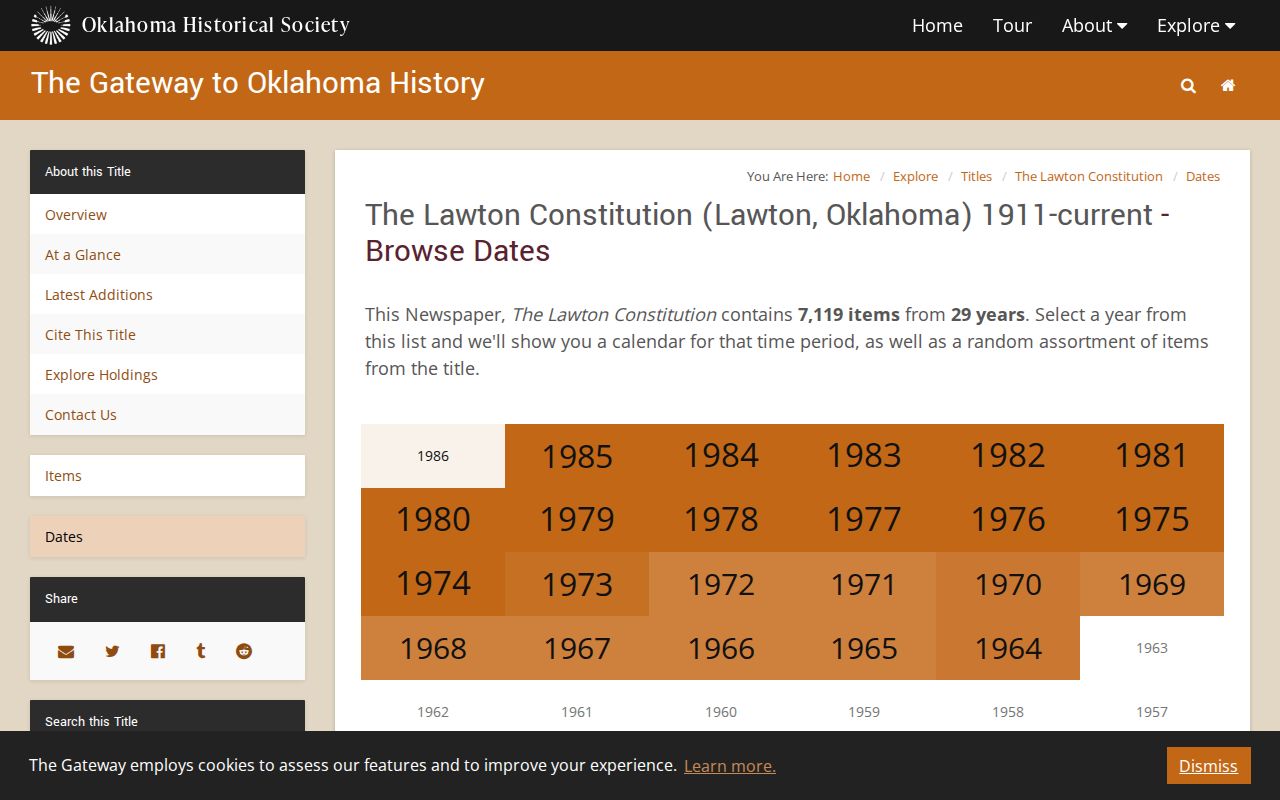
Old street language often differs from current use. The Oklahoma Historical Society advises searching “twelfth” as well as “12th,” and “northwest” as well as “NW.” A subdivision name or a nearby business can also reach an address mention that an exact modern spelling misses.
Lawton Research Beyond City Directories
The Oklahoma Historical Society Research Center supplies the state-level layer when a Lawton city directory ends too soon. Its genealogy holdings include cemetery books, vital indexes, county and family histories, Dawes and Five Tribes material, military records, and on-site research databases. Its home-history guidance follows a practical chain: identify the current address and legal description, search the County Clerk's records, then move between names, addresses, directories, newspapers, the catalog, and Sanborn maps. The last step adds building context, not proof that a particular person lived there.
Oklahoma Historical Society genealogy research describes the Research Center's collections, guides, and service route.
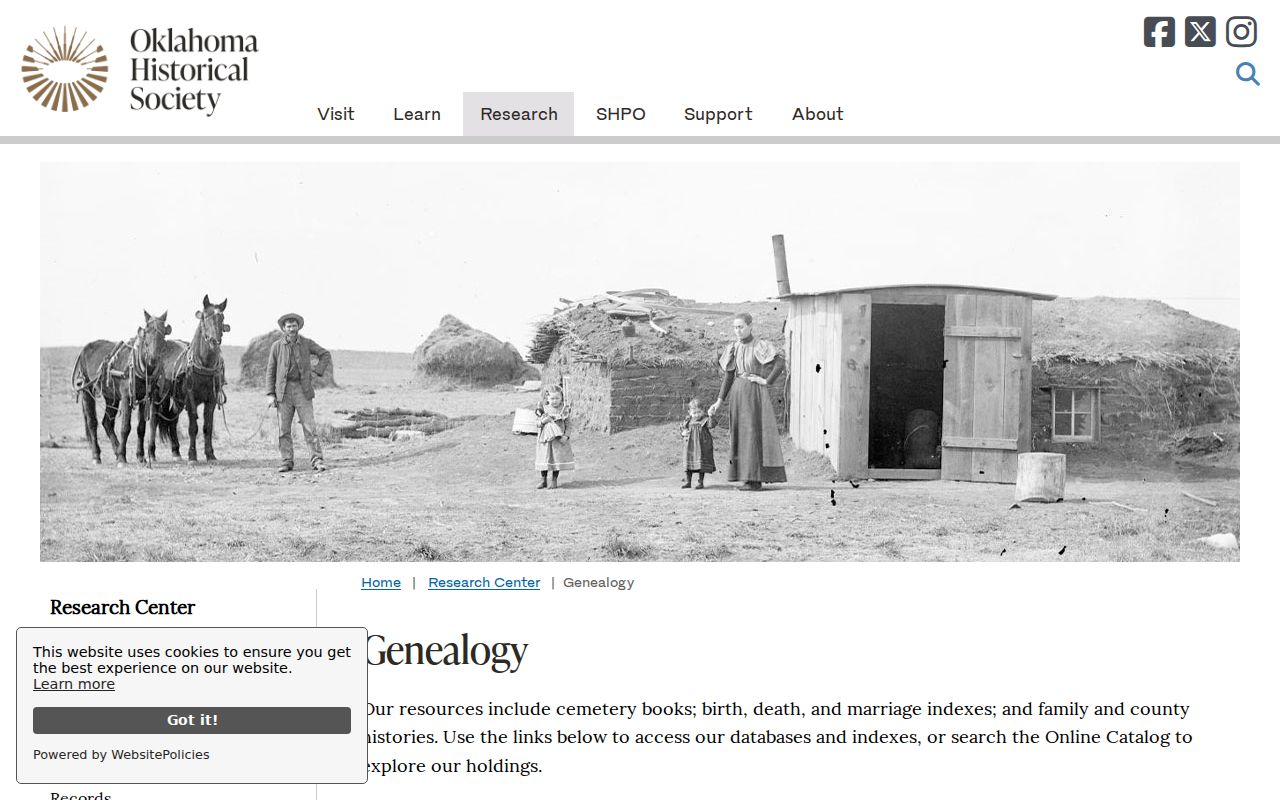
Lawton's library has a distinctive Native American collection as well. Kiowa, Comanche, and Apache enrollment, land, tribal-affairs, and cemetery materials can offer a separate path where an ordinary printed directory is incomplete or uses an unexpected name form.
Trace Lawton City Directory Households
Following a household works best as a sequence of small checks. Begin close to a known date and save the whole printed line. A surname by itself is weak evidence, especially when the directory uses initials. The annual intervals can then be paired with federal census schedules, which supply household relationships and ages but occur much less often. If a current record needs confirmation after a historical match, use the Lawton resident search for the separate task of checking one person through present-day sources.
- Locate the closest directory year with a known name, address, spouse, or occupation.
- Copy the full entry and, where available, check the address-order or reverse section.
- Follow the same name forward and backward one available edition at a time, recording moves and changed occupations.
- Pair the resulting address trail with the appropriate census decade, using the directory years to bridge the interval.
- Use newspaper, obituary, cemetery, probate, or church material to test whether a disappearance reflects a move, death, or a listing gap.
A disappearance proves little by itself. The person may have moved, died, married under another surname, been missed by a canvasser, or simply fallen in an unavailable year. Keep those alternatives open until an independent record supports one of them.
Lawton Church and Cemetery Trails
Church and cemetery sources can close a household trail, but each collection has its own access rules and date range. FamilySearch lists Oklahoma Church Records from 1897 to 1984 and includes Lawton examples from First Presbyterian and First United Methodist. The city's genealogy material also identifies First Baptist microfilm from 1902 to 1999 and First United Methodist material from 1901 to 1958. Those records may contain membership, baptism, marriage, death, residence, prior-church, or minutes information, depending on the collection. They are not a universal list of local residents.
FamilySearch's Oklahoma collection list includes Highland Cemetery Records for Comanche County, 1901-1994, with 26,550 records in the inspected collection list. The Lawton Library also has photocopied city-cemetery death records, while a direct public Highland Cemetery name-search was not located in the city sources.
The inspected Oklahoma county-marriage collection covers 1890-1995 but was only 47% complete at inspection. A missing result therefore does not settle a marriage question; check the local Court Clerk's paper file when the collection's coverage table calls for it.
Note: Match a cemetery or church clue to dates, address, relatives, and the original collection before attaching it to a directory household.
Lawton Microfilm Has a Moving Finish
Remote access is changing. In April 2025, the Oklahoma Historical Society announced a $25,000 Oklahoma Heritage Preservation Grant for Lawton Public Library to digitize newspaper microfilm for Gateway to Oklahoma History. The grant is useful news for directory research because newspaper pages can bridge a missing annual volume. It does not make every library issue available online at once, and the library's larger archive, Gateway's digitized set, and subscription or in-library services should still be checked separately.
| 1904 | Lawton Library's Constitution archive begins, subject to small microfilm gaps. |
|---|---|
| 1905 | Lawton Constitution reports the new R. L. Polk & Co. directory and its 2,484 principal names. |
| 2025 | OHS announces the $25,000 microfilm-digitization grant for Lawton Public Library. |
The OHS grant announcement is a reason to recheck Gateway and the library after an earlier online search fails. Availability is a moving target, while a shelf or microfilm inquiry remains the reliable fallback.