
Find Lawton Previous Residents by Era
Past residents are best traced with an era check first. Comanche County's online land index reaches a defined modern period, while the earlier deed trail belongs at the courthouse. Directories and newspapers can add occupants, but their runs have gaps and their dates must be read from the exact item. The table separates what each source can show from what it cannot prove, so a transfer of title is not mistaken for a household record.
| Lawton source | Years it covers | Where held | What it can show |
|---|---|---|---|
| County Clerk online land index and images | March 1987 to present | OKCountyRecords | Grantor, grantee, instrument, date, book/page or number, legal description, and image availability. |
| County Clerk older books and indexes | Earlier years; exact local cutoff not located | Room 304, 315 SW 5th Street | Earlier conveyances, mortgages, liens, and legal-description continuity. |
| Lawton directories and phone books | 1905 R. L. Polk documented; wider shelf run to verify | Lawton Public Library Family & Local History Room | Address, name, spouse, work, phone, or edition-specific notations. |
| Federal census | Historic release access; 1950 is the latest released census in 2026 | Census, NARA, and library databases | Household relationships, birthplace, work, and enumerated address or geography. |
| Lawton Constitution archive | 1904 to 2022, with small library gaps | Library microfilm, Access World News, and Gateway | Obituaries, sales, estates, address mentions, and neighborhood events. |
| Sanborn map leads | 1904, 1907, 1912, 1918, 1923; January 1931 cataloged | LOC, OHS, or library | Structure and street context, not ordinary resident names. |
Begin with the online clerk index when the purchase was recorded in or after March 1987. If the sought period is older, preserve the legal description and move directly to the County Clerk's older grantor-grantee books or microfilm. Use the library layers to test a person-at-address hypothesis, not to fill an unverified year with a guess.
Lawton Previous Residents After 1987
The Comanche County Clerk's online index says indexed data and images begin in March 1987 and are updated with new records in real time. That date is an access line, not the beginning of a Lawton address. The index can be searched by name, instrument number, book and page, recorded-date range, legal description, or structured subdivision and survey fields. A free index and hosted images do not make an image a certified copy.
The County Clerk's Land Records page is shown below.
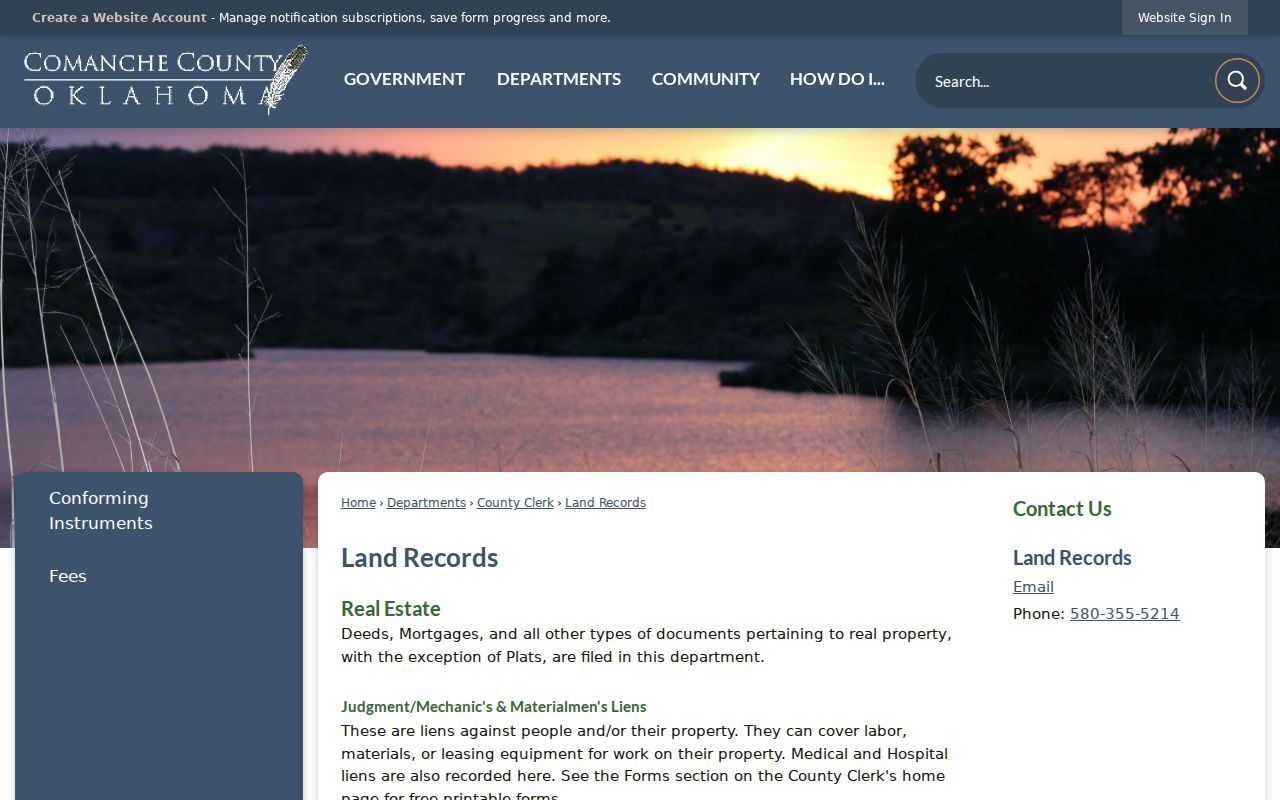
Start a past-resident trail by locating the current purchase instrument, then use its legal description and people named on the record to step backward. The index establishes a recorded interest, not residency at the address.
Lawton Previous Residents Before 1987
When the online index stops, the next channel is not a speculative date range online. Contact the Comanche County Clerk Land Records counter at 315 SW 5th Street, Room 304, Lawton, or call 580-355-5214. The county lists weekday counter hours of 8:30 a.m. to 5 p.m. Ask for the older grantor-grantee books or microfilm using the legal description and the names already identified. The research did not locate an official exact starting date for the older books or microfilm, so that gap remains important.
Older conveyances may use subdivision, addition, block, and lot language, or quarter-quarter, section, township, and range language. Those two forms can point to the same property through a plat or later deed. Keep the full description with every date and instrument reference. It is far more durable than a street label when a subdivision changes or an old address is hard to normalize.
Note: A missing online result before March 1987 signals a change of access channel, not an absence of Comanche County land records.
Trace Lawton Previous Residents Through Deeds
The deed chain is a backward sequence from the present parcel, not a broad name search. The Comanche County Assessor advertises owner and address searching, but its live field list was blocked during inspection. Use the available parcel result or the Assessor counter to anchor the current situs, mailing address, parcel or account number if available, subdivision, block and lot or section-township-range description. Then make the clerk index do the historical work.
- Locate the current property through the assessor by address or owner. Keep the situs and mailing address separate, then save the parcel and legal description if shown.
- Search the current owner as grantee in the County Clerk index. Identify the purchase instrument and verify that its legal description matches the parcel.
- Read the earlier grantor, or seller, on that instrument. Search that seller as grantee in an earlier date range to find the prior purchase.
- Repeat the grantee-to-grantor move, checking the legal description each time. Search spouses, trusts, LLC names, and spelling variants when the record calls for them.
- At the March 1987 line, take the same legal description and names to Room 304 for the older index books or microfilm.
- Grantor
- The party conveying an interest in a recorded instrument, commonly the seller on a purchase deed.
- Grantee
- The party receiving the recorded interest, commonly the buyer on that deed.
- Chain of title
- The sequence of recorded transfers linking an earlier interest to a later one. It traces land interests, not a full occupancy history.
- Legal description
- The land description used in deeds, such as a lot and block or a section-based description. It is more dependable than a street address for old records.
Lawton Previous Residents in Directories
Ownership is only one layer of who lived here before. Lawton Public Library confirms local and neighboring community directories and phone books, but it does not publish a complete criss-cross run online. A reverse or criss-cross directory starts from the address and may list an occupant clue for that edition. Read the whole entry: initials, spouse notation, occupation, telephone number, and edition-specific marks vary by edition and cannot be assumed when they are absent.
The 1905 Lawton Constitution reported that R. L. Polk & Co. delivered a local directory with 2,484 principal names. The report also said married women and children were omitted from that principal-name count. That makes it a useful local example and a warning against treating a directory count as a household count. The library's broader holdings, publishers, and catalog leads belong in the Lawton city-directory collections, while the practical task here is testing one address across available years.
Lawton Previous Residents and Census
Pair the address trail with census years only after the directory entry has been copied exactly. A directory may fill an annual gap, while the census can identify relationships within a household. Neither should override the other when the street, spouse, age, or location points in different directions. The current released historic federal census is 1950, so later household history needs directories, deeds, notices, and other date-specific records instead.
- Find the closest Lawton directory year and copy the address, names, abbreviations, and any spouse or occupation clue.
- Look for the nearest released census schedule using the same names and the correct historical geography.
- Compare household relationships with the directory's address. Record disagreement rather than forcing a match.
- Check the next available directory year for a first appearance, last appearance, address change, or spelling change.
- Use a deed, probate item, obituary, church record, or newspaper notice to corroborate a move, death, or estate event.
The flow is address directory, then census household, then another directory or a dated record. It is a way to test a timeline, not a method for declaring a person present during every year between two sources.
Note: Directory and census dates establish points in time, not a continuous record of one Lawton address or household.
Lawton Previous Residents in Newspapers
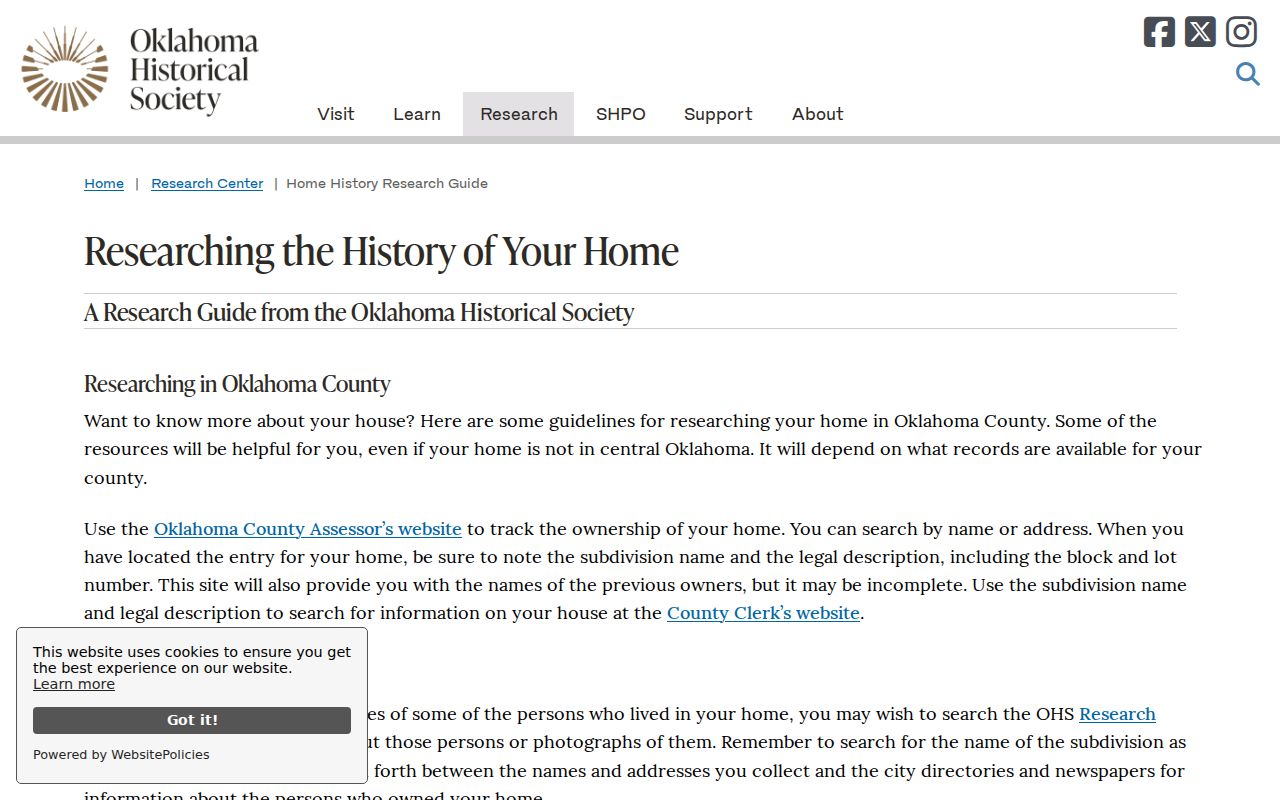
The Oklahoma Historical Society home-history guide sets out a useful Lawton sequence: start with the assessor, capture the subdivision and legal description, search the County Clerk, then consult catalogs, directories, and newspapers by both owner and subdivision. It also recommends searching old newspaper language flexibly. “Twelfth” and “northwest” can retrieve an older reference that a modern “12th” or “NW” query misses.
The method is illustrated in the OHS house-history guide below.
Lawton Public Library reports a Lawton Constitution archive from 1904 through 2022, with small gaps. Gateway offers narrower digitized ranges, so library microfilm and library databases may cover more than the freely digitized material. The library's Family & Local History lookup form accepts limited inquiries; more intensive work may require an in-person visit or other research service.
In April 2025, the Oklahoma Historical Society announced a $25,000 grant to digitize Lawton newspaper microfilm. That is a preservation effort, not a promise that every issue or address reference is already searchable.
Lawton Previous Residents and Sanborn Maps
Sanborn maps date the building and street setting, not the people in the building. Research leads identify Lawton editions for 1904, 1907, 1912, 1918, and 1923, but those are leads to investigate rather than claims of online availability. The Library of Congress directly catalogs a January 1931 Lawton Sanborn set with 35 sheets numbered 1 through 36, sheet 32 missing. That catalog record is marked not available online.
Use a map to check whether a structure, lot layout, or street pattern is plausible for the directory or deed period. A parcel's legal description, plat, and any official city street-name record remain the link between the map and the clerk index. Do not use a map's footprint as evidence that a specific person occupied the property.
Lawton Previous Residents Across Boundaries
Historic labels can change even when the land is familiar. Lawton began as a one-square-mile townsite in 1901. The city expanded through 1966 annexations, and it annexed Fort Sill on June 23, 1998. Comanche County's present boundaries were finalized when Cotton County was created in 1912. A pre-1912 search may need the historical county context rather than only the modern map or ZIP label.
There is no verified official Lawton-wide street-renumbering year in the inspected material. Use old directory spelling, plats, the legal description, and the City Clerk's corporate-boundaries map before deciding that an address changed. An unexplained mismatch is a research problem to resolve, not a reason to invent continuity.
Note: City limits, postal labels, Fort Sill context, and county jurisdiction can describe different aspects of one historic Lawton address.
Lawton Previous Residents: Lawful House History
A previous-residents search in Lawton is best kept to house history, family history, probate or heir research, and a focused question about a recorded property. The deed chain shows recorded interests; directories and census schedules can add time-bound household evidence; newspapers and probate records can provide endpoints. No one source creates a full profile of the people linked to an address.
Lawful use. Use Lawton house-history records for personal, historical, or civic research. Do not use past-resident information to stalk, harass, threaten, or intimidate any living person.